2026 Budget: How Tinubu Plans to Fund Security, Health, Education
President Bola Tinubu proposed a ₦58.18 trillion budget for 2026, focusing on security, education, and healthcare, amid challenges of execution and funding.
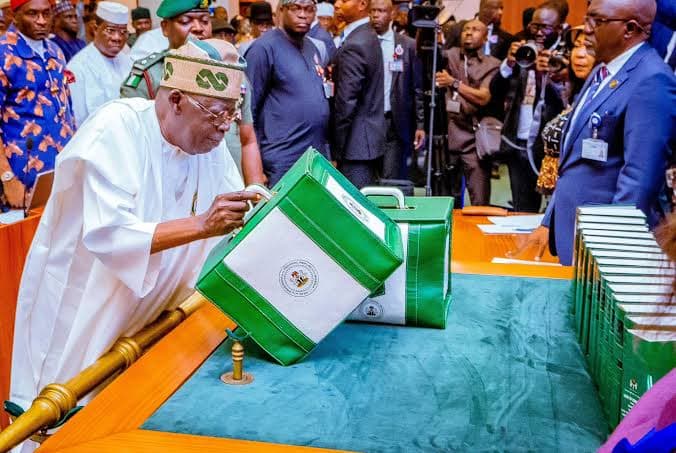
President Bola Tinubu’s proposed ₦58.18 trillion budget for 2026 now faces a test that Nigerians will feel beyond the National Assembly: can the spending produce safer communities, better roads, functioning schools, stronger hospitals and more jobs?
According to the State House, Tinubu presented the Appropriation Bill to a joint session of the National Assembly under the title “Budget of Consolidation, Renewed Resilience and Shared Prosperity". The proposal estimates revenue at ₦34.33 trillion, total expenditure at ₦58.18 trillion, capital expenditure at ₦26.08 trillion and recurrent non-debt expenditure at ₦15.25 trillion.
Debt servicing is projected at ₦15.52 trillion, while the deficit is put at ₦23.85 trillion, equivalent to 4.28 per cent of GDP. The plan is based on an oil benchmark of US$64.85 per barrel, production of 1.84 million barrels per day and an exchange rate of ₦1,400 to US$1.
Those assumptions will determine how much money the government can raise, spend and borrow. For citizens, however, the most important measure will be what changes on the ground.

The proposed allocations show where the government says its priorities lie: ₦5.41 trillion for defence and security, ₦3.56 trillion for infrastructure, ₦3.52 trillion for education and ₦2.48 trillion for health.
These figures are proposals, not proof that citizens have already benefited. The bill does not show which states, regions, projects or population groups will receive the largest share of capital spending. That information will help determine whether the plan reduces or widens existing gaps in roads, schools, hospitals and other essential services.
BusinessDay reported that the separate ₦54.99 trillion 2025 budget proposal allocated ₦6.11 trillion to security, ₦5.99 trillion to infrastructure, ₦5.7 trillion to education, healthcare and skills development, and ₦3.73 trillion to agriculture and food security.
The comparison shows the scale of recent budget plans, but large appropriations do not guarantee fair delivery. Where projects are located, how quickly funds are released and how well they are executed will matter as much as the headline amounts.
The government has linked the 2026 proposal to tighter budget execution and stronger revenue collection. According to the State House, President Tinubu said all capital liabilities from previous years would be funded and closed by March 31, 2026. From April, he said, Nigeria would operate on a single budget backed by a single revenue cycle.
“We are terminating the habit of running three budgets in one inflow,” Tinubu said. He also promised digitised revenue collection, automated reconciliation and closer monitoring of Government-Owned Enterprises, alongside reforms in taxation and the oil and gas sector.
The State House reported that revenue stood at ₦18.6 trillion, or 61 per cent of target, while expenditure reached ₦24.66 trillion, or 60 per cent of target, by the third quarter of 2025. It said ₦2.23 trillion had been released by June 2025 for 2024 capital projects after execution of that budget was extended to December 2025. By the third quarter, ₦3.10 trillion—about 17.7 per cent of the 2025 capital budget—had been released.
Those figures make oversight central to the government’s reform promise. Nigerians will need timely releases, clear spending reports and evidence that approved funds are reaching the projects for which they were allocated.
Capital spending could benefit security agencies, infrastructure users and contractors, schools and education workers, health institutions and patients, as well as the agriculture and food-supply sectors. But the proposed allocations do not identify which specific projects will be completed or when communities will feel the benefits.
The outcome will depend on project selection, procurement, fund releases and monitoring. It will also depend on whether the government can prevent abandoned projects, inflated contracts and poor execution—failures that can leave large appropriations with little visible effect.
President Tinubu said the government would focus on completing outstanding obligations rather than allowing overlapping budgets and perpetual rollovers. “The greatest budget is not the one we announce. It is the one we deliver,” he said, according to the State House.
For many Nigerians, the budget will be judged in practical terms: whether insecurity falls, food becomes more affordable, roads improve, schools function better and health services become easier to access.
Its size has also raised questions about revenue and debt. BusinessDay reported that the 2025 budget proposal projected ₦36.35 trillion in revenue and ₦16.3 trillion for debt servicing, while economists questioned whether the revenue target was realistic. The publication quoted a Nigerian Economic Summit Group analysis as saying, “Nigeria’s budget size has nearly doubled in just one year, yet the revenue structure remains weak.”
The State House reported that Tinubu cited economic growth of 3.98 per cent in the third quarter of 2025, compared with 3.86 per cent in the same period of 2024. It also said he reported that inflation fell to 14.45 per cent in November 2025 from 24.23 per cent in March.
These figures were presented as the President’s claims in the State House account and are not independently verified in the supplied material. Their real significance for households will depend on whether lower inflation and economic growth bring cheaper essentials, more jobs and stronger purchasing power.
As the proposal moves through legislative consideration, the government will need to show how it plans to achieve the ₦34.33 trillion revenue target and finance the ₦23.85 trillion deficit without putting excessive pressure on debt or squeezing other areas of spending.
Several practical questions remain. Will the March 31, 2026 deadline for closing previous capital liabilities be met? Which regions and projects will receive the largest share of capital spending? How much of the 2025 appropriations was actually released and spent, rather than merely approved?
Project-level details, regular release and spending reports, stronger independent oversight and safeguards against inflated contracts and abandoned projects would give Nigerians a clearer basis for judging the plan. The government must demonstrate that its proposed allocations can produce measurable improvements, rather than remain figures on paper.
The proposed ₦58.18 trillion budget sets out major spending commitments for security, infrastructure, education and health. Its success, however, will depend less on its size than on revenue performance, timely releases, oversight and fair distribution.
President Tinubu has described the plan as a reset of Nigeria’s budget process and pledged to end overlapping budgets. The coming months will show whether that promise—and the proposed sector allocations—leads to better services, stronger infrastructure, improved security and a more reliable food supply.
For citizens, the defining test is straightforward: can the government turn its commitments into projects and services that reach communities across Nigeria?