Pushing for Local Government Autonomy: A New Era for Nigeria
Nigeria’s local government autonomy debate has intensified after a school abduction in Oyo State, raising questions about grassroots security, funding and accountability.
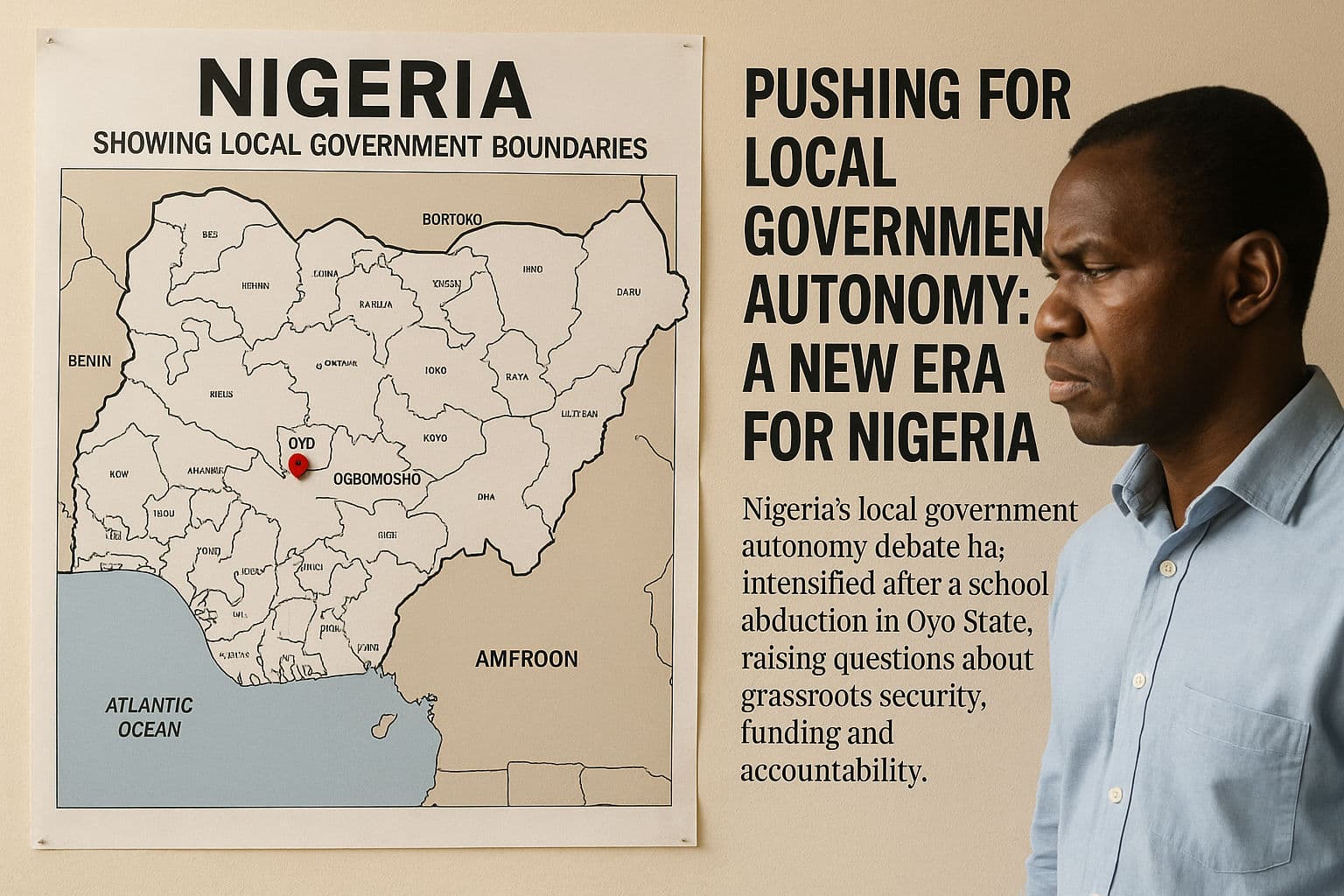
For communities far from state capitals, local government autonomy is not only a constitutional argument. It can determine whether a police station is functional, a road is passable, a health centre is open or help arrives when danger strikes.
That connection was brought into sharp focus in Oriire Local Government Area of Oyo State, where pupils and teachers were abducted from schools on May 15, 2026. They were later released after an operation involving the Nigerian Army, intelligence agencies and local security outfits. Security officials reportedly said no ransom was paid, although that claim has not been independently verified in the supplied material.
The incident renewed questions about how Nigeria’s 774 local government areas are governed, funded and protected. Residents in Oriire reportedly called for functional police stations, mobile network coverage, better healthcare centres, standard schools and improved roads. They also questioned how funds meant for grassroots development have been managed.
Across Nigeria, remote communities facing terrorism, banditry and kidnapping often share the same weaknesses: poor roads, limited telecommunications, inadequate healthcare and a weak presence of government. In such places, military operations may provide temporary relief, but they cannot by themselves deliver sustained security and public services in every vulnerable local government area.

Old Oyo National Park, which covers about 2,512 square kilometres across northern Oyo State and southern Kwara State, illustrates the challenge. Security experts, residents and local leaders have raised concerns about criminal groups using the park and surrounding forests as hideouts.
In Yawota, a community bordering the forest reserve, resident Damilare Amusa was quoted in a report attributed to TheCable as saying: “No light, no internet. The government should help us. If we had a network, we would have been able to call for help.”
Where formal protection is absent, residents may also turn to informal arrangements with armed groups. A 2024 example in Sabon Birni Local Government Area of Sokoto State, attributed to SBM Intelligence, involved levies or payments for access to farmland and protection. Such arrangements reflect the survival choices communities make when state institutions fail to provide basic security.
These realities have given the debate over local government autonomy a sharper edge. Supporters argue that councils, because they are closer to residents, are better placed to identify local needs and plan responses in areas such as roads, schools, healthcare, telecommunications and community security. They also say councils should control the resources allocated to them rather than depend heavily on state governments.
The debate is rooted in Nigeria’s long and unsettled history of local governance. The 1976 Local Government Reform was a major attempt to create a more structured system, but later military regimes and the centralisation of power weakened the ability of councils to serve their communities effectively. The 1999 Constitution established a framework for local government, yet its implementation has remained a source of contention.
The constitutional State Joint Local Government Account, established under Section 162 of the 1999 Constitution, has historically allowed funds due to councils to pass through state-level accounts. Council officials, labour unions and civil society groups have accused governors of deductions and expenditure controls. Those allegations are reported claims, not established findings in the supplied material.
On July 11, 2024, the Supreme Court, in Attorney-General of the Federation v. Attorney-General of Abia State and 35 others, ordered that allocations due to the 774 local government areas be paid directly to them. The court also barred states from retaining or spending council allocations and declared unelected caretaker administration of local governments unconstitutional.
The financial stakes are substantial. According to a PUNCH analysis of FAAC reports and data from the National Bureau of Statistics and the Office of the Accountant-General of the Federation, local government councils received N10.479 tn between the July 2024 and June 2026 FAAC meetings.
The period covered revenue earned between June 2024 and May 2026, because FAAC distributes revenue from a given month at the following month’s meeting. Allocations rose from N4.496tn between July 2024 and June 2025 to N5.984tn between July 2025 and June 2026—an increase of N1.488tn, or 33.10 per cent.
Average monthly allocations increased from N374.65bn in the first 12-month period to N498.67bn in the second, a rise of N124.02bn. During the 24-month period, N42.709 tn was shared among the federal government, state governments, local government councils and oil-producing states as derivation revenue. The Federal Government received N14.620tn, states N14.506tn, local governments N10.480tn and oil-producing states N3.103tn, according to the supplied PUNCH figures.
Yet higher allocations have not been matched by clear evidence of nationwide compliance with the Supreme Court judgment or a visible improvement in grassroots services. Key questions remain: are allocations being paid directly into the accounts of democratically elected councils, and how much of the N10.479tn reached councils without deductions or state-level control?
The debate has also included proposals for greater fiscal and administrative powers for local governments, as well as initiatives in states such as Lagos and Akwa Ibom aimed at improving council capacity through community engagement and participatory budgeting. Whether such approaches can be applied nationwide will depend on political will, oversight and the ability of councils to manage larger budgets transparently.
State governors and other political actors remain divided. Some governors see full autonomy as a threat to their influence, while critics of the councils’ current performance question whether many local administrations have the capacity to manage additional resources without stronger safeguards against corruption and management failures.
For residents of places such as Oriire, the test will not be found in legal arguments or budget announcements alone. It will be visible in safer schools, working health centres, passable roads, reliable phone networks and police stations that can respond when communities call for help.
Local government autonomy could widen political participation and make leaders more directly accountable to their constituents. But its success will depend on more than transferring money. Nigeria must also establish whether elected councils are functioning, whether the Supreme Court’s ruling is being followed and whether public spending is producing measurable improvements where people live.